Shang dynasty
I ChingThe Shang dynasty, also called the Yin dynasty in this account, appears as the setting for a political crisis that gave the early Yijing its urgent moral and political cast. The book’s account links the disorder under the dynasty’s last ruler to King Wen’s study of the lineal figures during imprisonment, and locates the formation of the early Text within the dynasty’s final years. It also separates that older Text from the later Appendixes, whose authorship and interpretation became matters of continuing debate.
Political Crisis and the Late Shang
The narrative describes the Shang kingdom as disorganized and demoralized under its rulers. A brother of the reigning king is cited as lamenting that the dynasty could no longer govern the land: the founder’s achievements had been undone, officials violated laws, crimes went unpunished, and people committed acts of violence against one another. The kingdom’s predicament is compared to attempting to cross a great stream without finding either a ford or a bank. This image presents political collapse not as an abstract change of dynasty but as a crisis in which ordinary order and safe passage had disappeared.
The account places particular responsibility on the last Shang ruler, King Shou of Shang. In the proclamation attributed to King Wu of Zhou, the ruler is condemned for slighting virtue, neglecting instruction, disregarding statutes and penal laws, and abandoning sacrifices to Heaven and Earth and offerings at the ancestral temple. The proclamation also accuses him of cruelty and of granting honors and confidence to bad advisers. Its argument is political as well as moral: because the ruler had alienated both Heaven and the people, his authority could no longer command their support. The disorder of the state and the ruler’s conduct are thus made mutually reinforcing explanations for the dynasty’s impending fall.
King Wen, Imprisonment, and the Lineal Figures
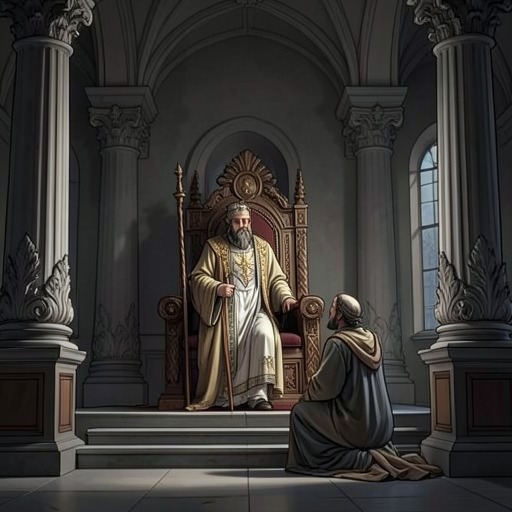
The account identifies King Wen as the western lord of Kâu, a principality whose rulers had long been known for ability and virtue. He had succeeded his father in 1185 BC and had become a kind of viceroy over a considerable part of the kingdom. Although princes and common people would, the author says, have welcomed his leading an attack on the tyrant, King Wen held back rather than risk appearing disloyal. His restraint did not prevent the suspicious King Shou from having him imprisoned at Youli in 1143 BC. His friends secured his release in the following year, but while imprisoned he faced the possibility that an order for his death might arrive.
The book’s account connects this confinement to King Wen’s work on the figures. Divination by trigrams was already familiar in China, and the use of tortoise shell and divining stalks is described as an established practice. The author suggests, without presenting it as certain fact, that studying the figures might also have appeared harmless to King Wen’s captors. The account then offers its own imaginative reconstruction: King Wen with the sixty-four figures before him, naming them for the ideas he associated with each and adding statements of warning or exhortation. In this interpretation, the figures become a means of bringing divination within the bounds of reason and of considering the qualities of nature, human society, and the condition of the kingdom.
The historical dating proposed in the book places the portion of the Yijing attributed to King Wen in 1143 or 1142 BC, during the crisis that led to his imprisonment. The author presents this attribution as only one part of the Text. A larger share is assigned to King Wen’s son, the Duke of Zhou, whose material includes references to King Wu and to events in the early years of the next reign. The account therefore describes the received Text as the product of more than one author and of a short but consequential period at the end of the twelfth century BC.
Divination: Medium, Procedure, and Scope
The account distinguishes the practice of divination from the later interpretations placed upon it. Tortoise-shell divination is said to be mentioned in an early document in the Book of Documents, while divination with lineal figures manipulated through plant stalks appears somewhat later. The plant is identified as Ptarmica Sibirica; the author reports having seen it growing near Confucius’s grave. In this history of practice, the Shang-era context of King Wen’s study belongs to an established culture of consultation rather than to an isolated invention.
The Appendix’s account of divination treats the tortoise and the stalks as spirit-like instruments endowed by Heaven with a subtle virtue. The author reports that a more skeptical view also appears in Chinese literature: a Ming-dynasty story dismisses the stalks as withered grass and the shell as a withered bone, arguing that a person should listen to himself rather than seek intelligence from objects. He contrasts that skepticism with the Appendix’s belief in the instruments’ efficacy. The distinction matters: the historical description of how divination was practiced is not identical to the claims made for its supernatural force.
The procedure described in the Appendix uses forty-nine stalks. Each line is formed through three manipulations, so that eighteen manipulations produce a hexagram. Odd numbers yield strong, undivided lines; even numbers yield weak, divided lines. The numbers 9, 8, 7, and 6 have specific roles in combining lines and forming the figures. Once the hexagram has been made, the operator turns to King Wen’s thwan and the Duke of Zhou’s emblematic sentences for interpretation. Numbers, in the author’s account, assist the operator in generating the figure; they do not function as independent entities that govern the material world.
The stated purpose of consulting the Yijing is also limited. It is not, in the author’s reading, a way to know future events absolutely. Rather, the consulter asks whether a contemplated scheme or set of circumstances is likely to turn out favorably or unfavorably. The language of the Appendix can mislead a cursory reader into treating the book as a means of predicting every possible occurrence, but the author argues that careful reading supports the narrower understanding. This distinction separates practical judgment about a proposed course from an unrestricted claim to foreknowledge.
Text, Appendixes, and the Work’s Transmission
The account stresses the chronological gap between the Text associated with King Wen and the Appendixes traditionally associated with Confucius. Even if Confucius had written the latter, the author argues, he could not have begun them before 483 BC—roughly six centuries after the material attributed to King Wen. The Appendixes are instead placed broadly in the Confucian period, probably between 450 and 350 BC, though the author treats their authorship as uncertain. He insists that the two parts should be distinguished rather than treated as one homogeneous work, since their different dates may reflect changes in how people understood the figures and their method.
The history of editing helped blur that distinction. The first Han scholar Pî Kih arranged five Appendixes, by the common reckoning, alongside the Text in standard editions. The author considers this intermixture a source of confusion for foreign readers because it places ideas from different periods together. Native scholars, he notes, were aware of the chronological difference: the imperial Khang-hsî edition printed Text and Appendixes separately. Yet questioning their unity or denying that all the Appendixes came from Confucius could carry a reputational cost, since such criticism risked appearing to challenge the sage’s infallibility and invite a charge of heterodoxy.
The book also traces the Yijing’s survival and its long interpretive afterlife. It escaped the Qin book burning of 213 BC because the measure, as described here, exempted works on medicine, divination, and husbandry; the Yijing was preserved as a book of divination. By the beginning of the Common Era, Liû Hin’s catalogue listed works on the Yijing and its Appendixes from thirteen authors or schools, comprising 294 portions. The imperial edition published in 1715 quoted 218 scholars whose commentaries extended across many centuries. The account invokes those figures to show that interpretation was neither a brief nor a marginal enterprise: generations of readers worked to make the text intelligible, even where the Appendixes remained difficult.
Historical Meaning and Interpretive Limits
The Shang crisis gives the account a context for reading the early Yijing as more than a device for producing divinatory figures. Under King Wen’s attributed work, the hexagrams acquire moral, social, and political meanings, and the appended judgments warn against danger, carelessness, and the loss of security. The author’s reconstruction links that mode of interpretation to a ruler who had to navigate the danger of imprisonment and the wider disorder of the kingdom. It remains a proposed interpretation of the text’s origins, rather than direct proof of every circumstance described.
The account’s distinctions are central to its historical argument: the Shang-era political setting is not the same thing as the date of every part of the received book; the earlier Text is not interchangeable with the later Appendixes; and the use of divination is not equivalent to a promise of absolute prediction. The dynasty’s collapse supplies the political pressure surrounding the book’s earliest attributed layer, while later editors and commentators shape how that layer is read. In this telling, the Yijing’s history is therefore also a history of interpretation: a work associated with crisis and consultation becomes a classic whose meaning is repeatedly reconstructed across centuries.